Call Center Outsourcing: The Complete Guide for Businesses Ready to Stop Missing Calls

If your phones go unanswered after 5 pm, your front desk is stretched thin, or you’re losing leads because no one picks up, call center outsourcing might be the most straightforward fix your business hasn’t tried yet.
Outsourcing your call center means partnering with a provider whose trained agents handle your inbound calls, outbound follow-ups, and customer support on your behalf, 24 hours a day. You get professional call handling without the overhead of building an in-house team. And your customers get a live person every time they call.
Here’s what this guide covers:
What Is Call Center Outsourcing?
Call center outsourcing is the practice of hiring a third-party provider to manage your business’s phone-based customer interactions. Instead of running an in-house contact center, you partner with a team of trained call center agents who answer calls, handle customer inquiries, take messages, and capture leads on your behalf.
It’s a form of business process outsourcing (BPO) focused specifically on customer communication: inbound support, outbound follow-ups, after-hours coverage, and overflow call handling.
Why do companies outsource their call centers?
Companies outsource their call centers to reduce operational costs, ensure 24/7 coverage without staffing overnight shifts, and deliver a more consistent customer experience. Outsourcing also frees internal teams to focus on core business functions rather than managing phone traffic.
What Does an Outsourced Call Center Actually Do?
A quality outsourcing provider becomes an extension of your team. Your agents learn your protocols, use your language, and represent your brand the same way an in-house receptionist would.
Depending on your business needs, call center outsourcing services typically include:
Inbound call handling: Answering customer calls, routing inquiries, and escalating urgent issues per your instructions.
After-hours and overflow coverage: Ensuring every call is answered even outside business hours or when your team is at capacity.
Lead capture and intake: Gathering caller information so no new business opportunity slips through.
Help desk support: First-call resolution for common issues, with escalation protocols for anything more complex.
Outbound calling: Follow-ups, appointment reminders, and sales call support.
Multilingual support: Serving customers in their preferred language across your entire contact center.
Tired of calls going to voicemail after hours?
Unicom Teleservices has provided 24/7 live answering and call center services since 1990. No long-term contracts. No offshore handoffs. Just real people representing your business around the clock.

The Benefits of Outsourcing Call Center Services
The benefits of call center outsourcing go beyond cost savings. The bigger wins for most businesses are availability, consistency, and the time you get back to focus on your core business.
How Outsource Call Center Services Help You Control Costs
Building and staffing an in-house contact center is expensive. According to SHRM, the average cost to hire a single employee runs between $4,000 and $20,000, before salary, benefits, and training. For a team covering evenings, weekends, and holidays, those numbers multiply fast.
Outsourcing converts that fixed overhead into a predictable monthly expense. You pay for what you use. You don’t pay for downtime, turnover, or quiet overnight hours.
Your Customers Reach a Live Person Every Time They Call
Missed calls cost real money. With an outsourced call center, every inbound call is answered by a trained live agent around the clock. Not a voicemail. Not an automated phone tree. A real person who knows your business and follows your protocols.
Call Center Outsourcing Gives You Flexibility to Scale
Call volume doesn’t stay constant. It spikes during busy seasons and drops during slow ones. An outsourced call center absorbs those fluctuations without requiring you to hire and fire staff around them.
That flexibility is almost impossible to replicate in-house, especially for businesses that are growing or have seasonal demand patterns.
Consistent Call Handling and Better Customer Satisfaction
Inconsistency is one of the most common problems with in-house phone coverage. Different staff, different answers. Busy periods lead to rushed calls. After hours, nothing.
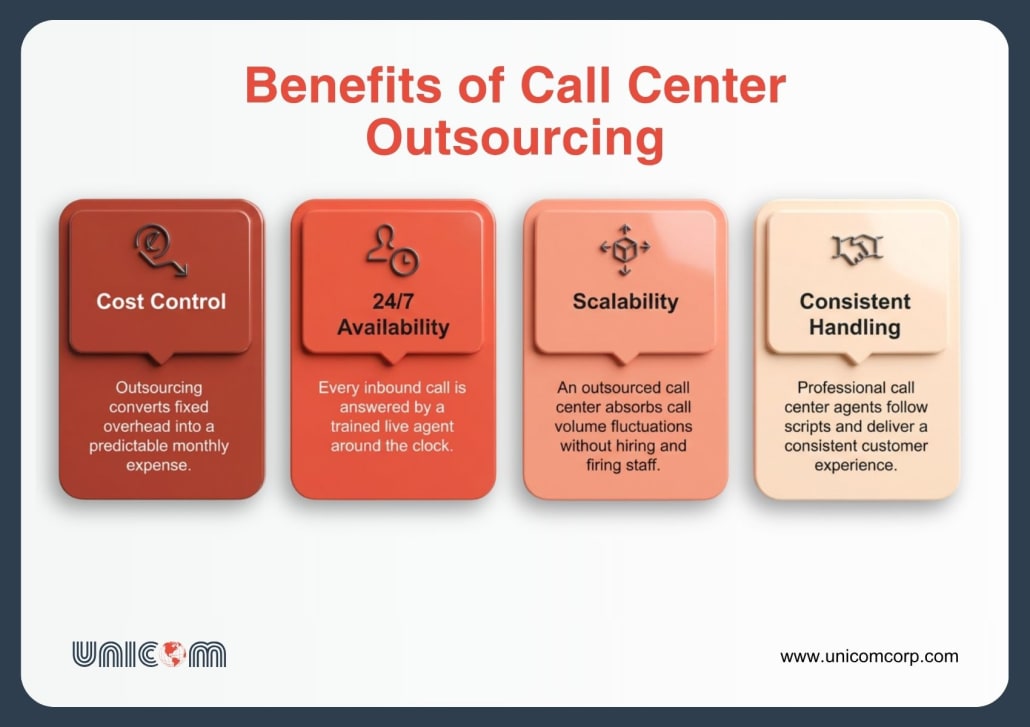
Professional call center agents are trained specifically for this work. They follow your scripts, capture the right information, and deliver a consistent customer experience on every call. PwC research found that 73% of consumers say customer experience is a key factor in their purchasing decisions, and consistent call handling directly affects that experience. That consistency improves customer satisfaction and retention.
Is U.S.-based call center outsourcing worth the higher cost?
For most businesses, yes. U.S.-based agents deliver better first call resolution rates, stronger compliance for regulated industries like healthcare and legal, and a more consistent customer experience than offshore alternatives typically provide.
Inbound and Outbound Call Center Outsourcing Services
Not all call center outsourcing is the same. The two primary categories are inbound and outbound, and most businesses need a mix of both.
Outsource Inbound Call Center Services: What’s Included
An inbound call center handles calls that customers initiate. This is where most businesses start with outsourcing, because the stakes around every missed inbound call are immediate.
Common inbound call center services include customer support and inquiry handling, after-hours and overflow answering, order taking and appointment scheduling, help desk support, and emergency dispatch for HVAC, plumbing, medical, and property management businesses.
Outbound Call Center Services
An outbound call center makes calls on your behalf, typically for follow-up, retention, and sales activity. This includes sales call outreach, customer retention calls, appointment reminders, and customer satisfaction surveys.
Omnichannel Contact Center Support
Many outsourcing companies now offer omnichannel support, handling customer interactions across phone, email, live chat, and SMS from a single team. If your customers expect to reach you through multiple channels, ask about this when evaluating outsourcing partners.
U.S.-Based vs. Offshore Call Center Outsourcing
One of the first decisions you’ll make when exploring call center outsourcing is whether you want a domestic or offshore provider. Both have real trade-offs.
The Case for U.S.-Based Call Center Outsourcing
U.S.-based agents share the same cultural context as your customers. They handle nuanced conversations more naturally, without the accent friction that offshore interactions sometimes create.
For businesses in regulated industries, domestic providers also offer clearer compliance pathways. HIPAA compliance is significantly easier to enforce and verify with a U.S.-based outsourcing provider than with an offshore operation.
Does Offshore Call Center Outsourcing Affect Service Quality?
Offshore call center outsourcing, most commonly through providers based in the Philippines or India, typically offers lower per-agent costs. The Philippines generates over $29 billion annually in BPO revenue, built on a large English-speaking workforce trained for customer support roles.
The trade-offs are real, though. Accent differences, time zone gaps, and cultural mismatches can hurt first call resolution rates and customer satisfaction scores. For complex or relationship-driven interactions, offshore outsourcing often introduces friction that offsets the cost savings.
Is outsourced phone support a good fit for small businesses?
Yes. Small businesses often benefit the most from call center outsourcing because they can’t afford 24/7 in-house coverage but still need every call answered. Outsourcing gives small businesses professional, round-the-clock call handling at a fraction of the cost of building an internal team.
How to Choose a Call Center Outsourcing Partner
The right outsourcing partner is invisible to your customers because they feel like your team. The wrong one is very visible because callers notice.
Choosing a Call Center Outsourcing Partner: What to Look For
When evaluating outsourcing companies, focus on these factors:
In-house vs. contractor agents: Providers who use direct employees consistently outperform those relying on contractors for training compliance and service quality. High agent turnover is one of the biggest drivers of inconsistent call handling.
Industry experience: Ask for specific examples of how they handle your type of calls and whether they’ve worked with businesses in your industry.
Compliance certifications: For , HIPAA and HITECH compliance are non-negotiable. Ask to see certifications and their business associate agreement process.
Analytics and reporting: You should have full visibility into call volume, handle times, and key performance indicators. If a provider can’t show you the data, move on.
Contract terms: Avoid long-term contracts without a clear service quality guarantee. Month-to-month agreements give you the flexibility to switch if the service doesn’t meet your standards.
For a deeper look at what separates a great partner from a mediocre one, read our guide on hiring a call center based on quality, not price.
Get 24/7 Call Center Coverage: Outsource to Unicom Teleservices Today
At Unicom Teleservices, we’ve been providing professional call center and answering services to businesses across the U.S. since 1990. Every agent on our team is an in-house employee, trained on your protocols before they ever answer one of your calls.
We don’t use contractors. We don’t offshore. We don’t put your customers through an automated system when they’re trying to reach a person.
What we offer:
24/7 live agent coverage with real people on every call, including holidays.
HIPAA, PHI, and HITECH compliance built in for medical clients.
Seamless system integration with your existing CRM, scheduling, and dispatch tools.
No long-term contracts and transparent pricing with no surprise fees.
We also handle overflow call center support for businesses not ready to fully outsource.